
Terms have communities.
We will keep recurring TCG language consistent while recognizing that the same word can carry different meanings across games.

A Japanese dōjin anthology / English edition in production
Beyond formats.
Beyond games.
Ten players and thinkers examine the foundations of stronger card-game play—from probability and statistics to intuition, original decks, and teaching.
English title and cover treatment are working editorial directions, not final publication data.
What this field is trying to do
General TCG Theory was proposed as a new field for raising players’ fundamental strength. It looks for ideas about card-game skill that can travel beyond one metagame or title—and for bridges from TCG practice to theory and science.
This is not a promise of one universal system. It is an anthology: ten authors approaching misplays, probability, data, simulation, deck construction, intuition, observation, and teaching from different competitive backgrounds.
01
The Original Edition
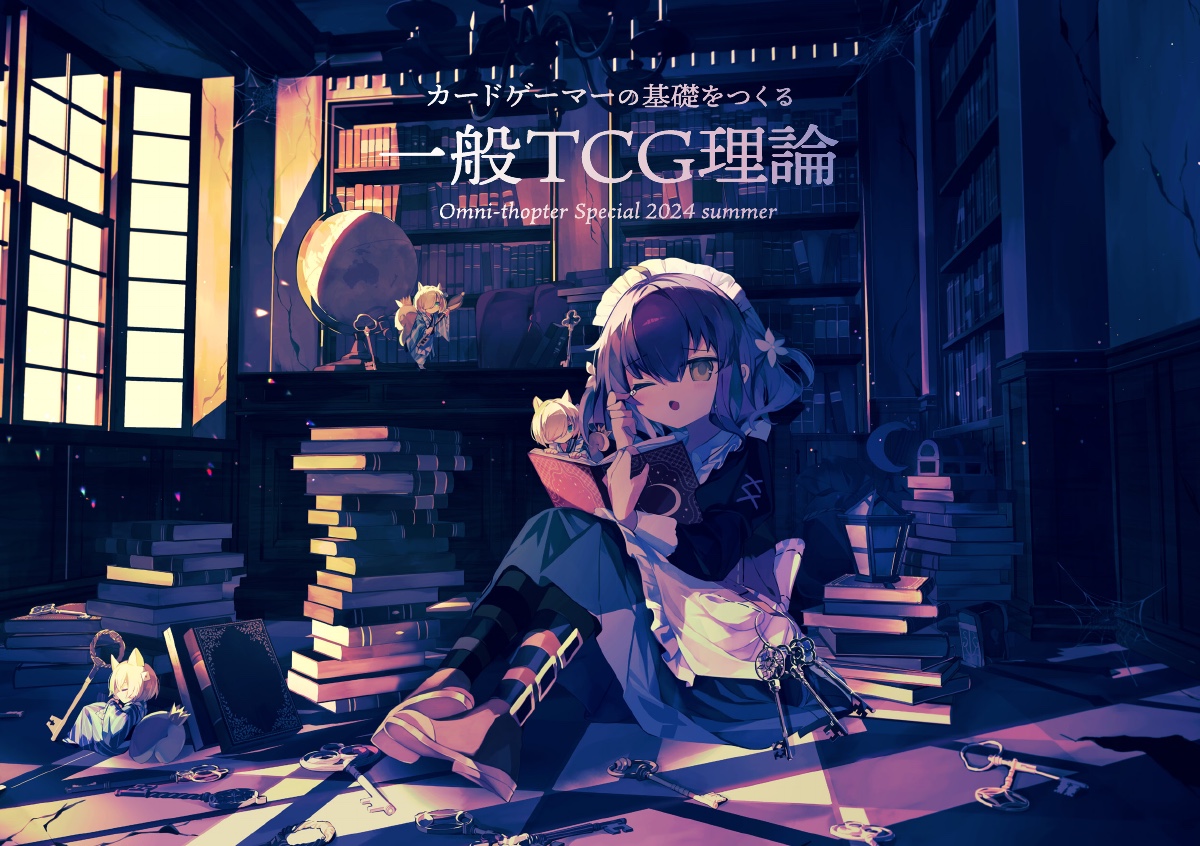
Originally published in Japan as 『一般TCG理論』, an independently edited A5 anthology.
Each author takes a different route through decision-making, probability, statistics, simulation, deck construction, observation, intuition, or teaching. The source edition gives those arguments room to develop through chapter openings, diagrams, and dense multi-column pages.
02
Ten Essays
Decision Making
Selected results: 4th place, ONE PIECE CARD GAME National Championship / No. 1 final rank, DUEL MASTERS PLAY’S Ranked Match
Starting from the premise that even elite players make mistakes, this essay asks how to create unfamiliar positions, make the opponent’s best choice harder, and turn relative skill—not luck alone—into wins.
Working English title and summaryProbability
Selected results: Top 4, Shadowverse EVOLVE GP Kyoto 2025 / Shadowverse Ratings Cup participant
Exact win rates are rarely available in real play. This introduction shows how ranges, boundaries, and simple models can still compare choices and connect uncertain information with probabilistic reasoning.
Working English title and summaryReasoning
Selected results: Level 1 Magic: The Gathering Judge (IJP) / Top 4, 17th Vintage God Challenger Tournament
Academic writing and deck building share a method: gather information, identify evidence, and test data. This essay explains how to question numbers and articles while still building and trusting your own argument.
Working English title and summaryStatistics
Selected results: Eight Arena Open cash finishes / Four Qualifier Weekend Day 2 appearances
Using the MTG Limited platform 17Lands, this essay examines both the power of win-rate data and the limits introduced by bias and context—then asks when statistics should guide a decision and when they should be set aside.
Working English title and summarySimulation
Selected results: Top 4, MTG Japan Championship 2021 Season 3 / Top 16, Little Prince Cup Pacific Region
A Monte Carlo simulation repeatedly models Swiss tournaments from metagame shares and matchup win rates. The gaps between model and result become language for revising format knowledge and deck selection.
Working English title and summaryDeck Construction
Selected results: 2021–2022 Magic Pro League / Official MTG broadcast commentator
Time spent refining an established Tier 1 deck and time spent exploring an unknown deck form an investment portfolio. This essay looks for metagame openings created by bias, and for rules to continue or abandon the search.
Working English title and summaryTheory
Selected results: Winner, RAGE Shadowverse Wonderland Dreams / Runner-up, Shadowverse EVOLVE Japan Championship 2024
Theory loses information when experience is put into words, and it does not always lead directly to victory. This essay argues for using trained intuition in routine play and reserving deliberate thought for pivotal branches.
Working English title and summaryObservation
Selected results: 3rd place, New Capenna Championship / 2022 World Championship competitor
Between a scripted opening and a calculable endgame lies the position that cannot be fully read. Through MTG examples, this essay defines a broader board sense for prioritizing position, life, and resources.
Working English title and summaryIntuition
Selected results: 14th place, 2022 World Championship / 6th place, Innistrad Championship
Intuition is treated as immediate recognition grounded in experience. By relating fast System 1 thinking to deliberate System 2 reasoning, this essay explores how reflection can correct intuition and strengthen judgment and invention.
Working English title and summaryTeaching
Selected results: Card Rush Pros (2019–2023) / RAGE esports operations and pro-league launch
Being a strong player is not the same as being a strong teacher. This essay separates generating options from choosing among them, and considers instruction that begins with the learner’s assumptions rather than hindsight.
Working English title and summary03
Inside the Japanese Edition
The samples include the book’s overview, contributor profiles, essay openings, body text, and diagrams. An English sample will follow after translation and layout review.
Sample spreads
04
Translation & Editorial Work
We will keep recurring TCG language consistent while recognizing that the same word can carry different meanings across games.
Japan-specific play and publishing contexts will be explained where needed, not silently replaced with invented equivalents.
The English essay titles on this preview are working translations. Final titles, credits, and review details will follow editorial confirmation.
English Edition / In Production
Release date
TBD
Format
TBD
Price
TBD
Sample & purchase
Coming later
No release date, price, final cover, or purchase link has been announced on this preview.
05
The Other Half of the Series
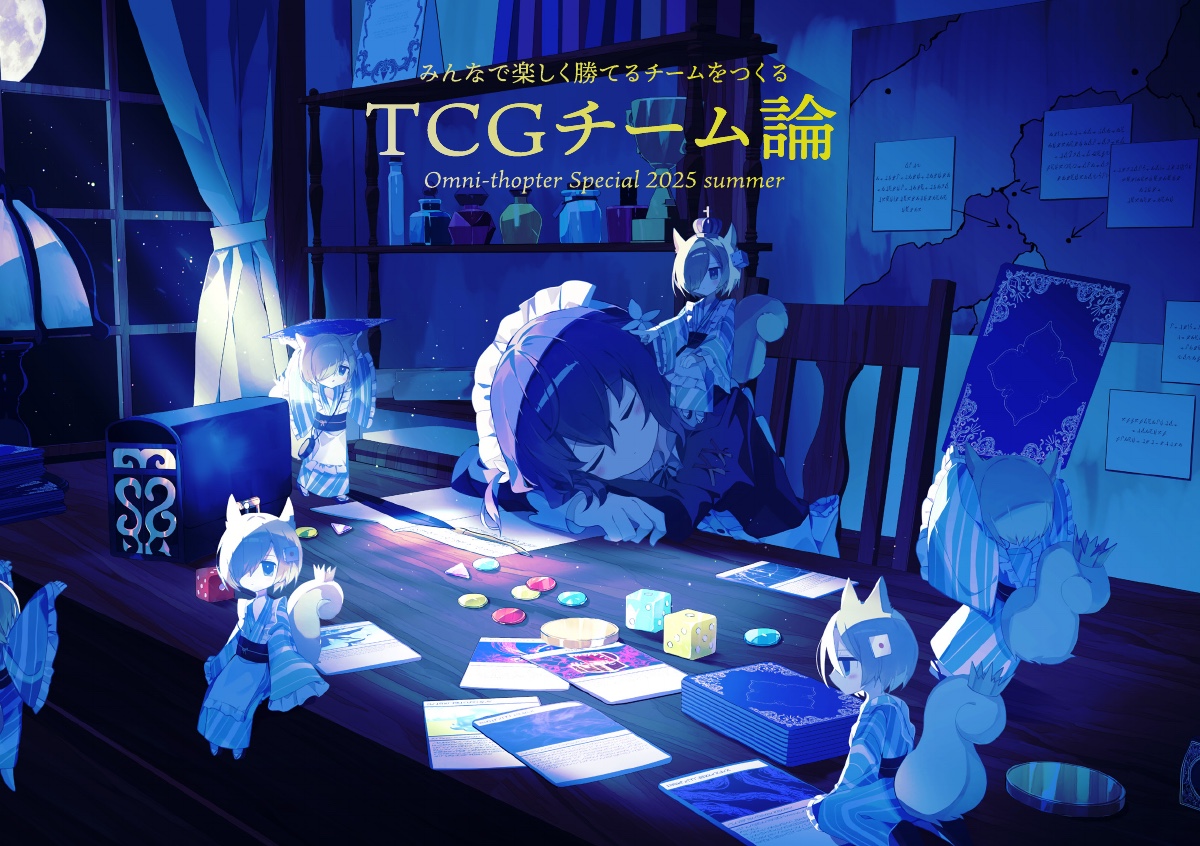
Japanese only
General TCG Theory asks how an individual player thinks. Its companion volume asks why players form teams—and how they learn, communicate, and keep competing together.
View on the Japanese series page